Tampilkan postingan dengan label legend. Tampilkan semua postingan

Astronomical Alignments of Ancient Structures


Unsolved mystery - I have grasped the stake... I take the measuring cord in the company of Seshat. I consider the progressive movements of the stars. My eye is fixed upon the Bull's Thigh [Ursa Major]. I count off time ..... and establish the corners of the Temple.

The above text is an inscription from the Temple of Horus at Edfu accompanying the relief showing "Stretching the Cord" Ceremony.
The Pharaoh and the Goddess Seshat, planting stakes linked by
a looped rope, participate in the 'Stretching the Cord' ceremony.
A Great Circle drawn through the celestial poles divides the sky, marking out a point on the celestial equator from which measurement can begin. This is what is meant by 'Stretching the Cord', creating the first path across the trackless waste.

The Mayan celebration of the establishment of creation is a description of the process of surveying the world:
'Great is the recital, the history of the time when all the corners of the sky and earth were completed, and the quadrangulation, its measure, the four points, the measuring of the corners, the measuring of the lines, in heaven, in earth, at the four corners'  (From the Mayan text of The Popul Vuh)
A more recent translation makes this even clearer; 'The fourfold siding, fourfold cornering, measuring, fourfold staking, halving the cord, stretching the cord in the sky, on the earth, / the four sides, the four corners as it is said '

The pillars which support the sky are to be regarded as benchmarks, boundary stones put down to enable an order to be imposed upon chaos, and a measure to be made of the earth. However, it should be apparent after all this discussion of the 'corners of the earth', that it is not the earth we walk about on that is of concern here. This particular 'earth' is not only square but flat. Exactly what this means will soon become clear. We should recall that it is the matter of Time that is being measured in this surveying process. This is the process that the prophet Enoch describes when, during his vision he asks his guide to explain the actions of the angels they see:

'Wherefore have they taken those long ropes and gone forth? He said 'They are gone forth to measure. These measures shall reveal all the secrets of the depths of the earth' (Book of Enoch ch. LX v. 2-6)

The process these Angels were going forth to conduct must have been similar to that ceremony which in Egypt was known as 'stretching the rope' and which accompanied the commencement of any building project, thus relating its construction to the original founding of the earth.

In the Old Testament Book of Job, God challenges Job to answer:

'Where wast thou when I laid the foundations of the earth? ..Who decided the dimensions of it... or who stretched the measuring line across it? What supports its pillars at their bases? (Jerusalem Bible tr.)'

This process of surveying the foundations of creation reappears in the verses of the Rig Veda which tell how Varuna made fast the earth and heaven, and here we are told specifically that he did so by using the sun as a measure, and as a commentary on these verses points out, 'we must take this measure as a measuring line'.
As if to emphasise the importance of this role of surveying, the Chinese deities responsible for creation come equipped with compass and plumbline.

What all this means is that the 'bindings' which hold heaven and earth together are to be taken also as plumblines which stretch out the measures of creation across the circle of the stars. It is a particular state of order that is being held fast.

Representations of the cosmos constructed in this way appear again and again, often in unlikely places.
An elemental one is the rectilinear cross which appears on the English flag ( the Royal Orb is a more complete image, including as it does the spherical universe bounded by the cross). Another more detailed example from China comes in the form of a series of mirrors known as the TVL mirrors, because of their decorative patterns, described as follows:

'The four T's that stand around the square earth are the four cardinal points. These lie at the extremities of the two cosmic lines or ropes which cross the universe and hold it together; the T's comprise a vertical prop which supports a horizontal beam; the four V's mark the four corners of heaven. The four L's represent devices used by carpenters to set a straight line...thus they symbolize the ends of the two cosmic lines as if they had been drawn with the help of such an instrument.'
[Related link: 
http://www2.uiuc.edu/unit/ATAM/archaeometallurgy/chimir.html ]
Bronze Mirror, 7th Century
 
For the Maya people today this kind of creation is still repeated as part of ceremonies to restore the correct balance of the world. David Freidel describes a ceremony he witnessed to bring to an end a prolonged drought. The officiant (referred to as h-men, 'a do-er') constructed an altar known as a 'sky-tree'. A table is overarched by four saplings bent to intersect above its centre. From this intersection is hung a circular platform referred to as the 'the sky-platform' .

'Sturdy vines of a kind called xtab ka'anil, 'the 'cords of the sky', completed the arches to form the 'sky tree'. In the Yukatek language, the words for 'sky' and the number 'four' are near homophones and frequently substitute for each other in the ancient writing system'.
Source: http://www.mythofcreation.co.uk/CreationText/Creation4_1text.htm

Mysterious Alignment of Ancient Sites of the World


The sites: Giza, Siwa, Tassili n'Ajjer, Paratoari, Ollantaytambo, Machupicchu, Nazca, Easter Island, Aneityum Island, Preah Vihear, Sukhothai, Pyay, Khajuraho, Mohenjo Daro, Persepolis, Ur, Petra  are shown clockwise from Giza on the equal azimuthal projection. below. The projection is centered on the axis point in southeastern Alaska. Distances to any location from the center of an equal azimuthal projection are equally scaled. Since all of the sites on the great circle alignment are equally distant from the axis point at one quarter of the circumference of the earth, the alignment forms a perfect circle halfway between the center and the outer edge of the projection.
The locations of world's ancient sites on a global scale is puzzling on its own. However, our discussion is focused on astronomical alignments of these sites and their monuments.

Posted in , , | Leave a comment

Mystery of The Voynich Manuscript


Unsolved mystery - Based on the evidence of the calligraphy, the drawings, the vellum, and the pigments, Wilfrid Voynich estimated that the Manuscript was created in the late 13th century. The manuscript is small, seven by ten inches, but thick, nearly 235 pages. It is written in an unknown script of which there is no known other instance in the world. 

The Voynich Manuscript is considered to be 'The Most Mysterious Manuscript in the World'. To this day this medieval artifact resists all efforts at translation. It is either an ingenious hoax or an unbreakable cipher. The manuscript is named after its discoverer, the American antique book dealer and collector, Wilfrid M. Voynich, who discovered it in 1912, amongst a collection of ancient manuscripts kept in villa Mondragone in Frascati, near Rome, which had been by then turned into a Jesuit College (closed in 1953).
 
The Voynich Manuscript is a cipher manuscript, sometimes attributed to Roger Bacon.
Scientific text in an unidentified language, in cipher, possibly written in central Europe in the 15th century.
It is abundantly illustrated with awkward coloured drawings of::
  • unidentified plants; 
  • what seems to be herbal recipes; 
  • tiny naked women frolicking in bathtubs connected by intricate plumbing looking more like anatomical parts than hydraulic contraptions; 
  • mysterious charts in which some have seem astronomical objects seen through a telescope, some live cells seen through a microscope; 
  • charts into which you may see a strange calendar of zodiacal signs, populated by tiny naked people in rubbish bins.
Detail from page 78r of Voynich Manuscript depicting the "biological" section
"Tiny naked women frolicking in bathtubs" - a fragment of page 70
Copyright: Beinecke Rare Book and Manuscript Library, Yale University
Page 70r  Image Source >>
No one really knows the origins of the manuscript. The experts believe it is European  They believe it was written between the 15th and 17th centuries.
From a piece of paper which was once attached to the Voynich manuscript, and which is now stored in one of the boxes belonging with the Voynich manuscript holdings of the Beinecke library, it is known that the manuscript once formed part of the private library of Petrus Beckx S.J., 22nd general of the Society of Jesus.
A sample of untranslatable text from the Voynich manuscript
There is no other example of the language in which the manual is written.
It is an alphabetic script, but of an alphabet variously reckoned to have from nineteen to twenty-eight letters, none of which bear any relationship to any English or European letter system. The text has no apparent corrections. There is evidence for two different "languages" (investigated by Currier and D'Imperio) and more than one scribe, probably indicating an ambiguous coding scheme.
The VM is written in a language of which no other example is known to exist. It is an alphabetic script, but of an alphabet variously reckoned to have from nineteen to twenty-eight letters, none of which bear any relationship to any English or European letter system. 
Apparently, Voynich wanted to have the mysterious manuscript deciphered and provided photographic copies to a number of experts. However, despite the efforts of many well known cryptologists and scholars, the book remains unread. There are some claims of decipherment, but to date, none of these can be substantiated with a complete translation. 
View Voynich photos
curtesy of the Beinecke Rare Book & Manuscript Library, Yale University.
To see all images go to
http://beinecke.library.yale.edu/digitallibrary/
and search for "Voynich Manuscript"
Few Examples:

Click on image to enlarge. Page 70r  Image Source >>
Copyright: Beinecke Rare Book and Manuscript Library, Yale University
Page 85v.
Copyright: Beinecke Rare Book and Manuscript Library, Yale University

Posted in , , | Leave a comment

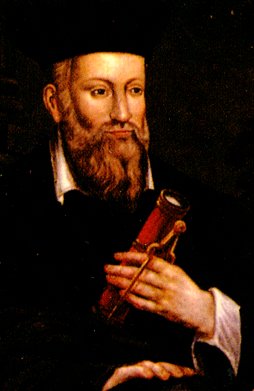
Michel Nostradamus (1503-1566)

Unsolved mystery - Michel Nostradamus (1503-1566) was a 16th century French physician and astrologer. His modern followers see him as a prophet. His prophecies have a magical quality for those who study them: they are muddled and obscure before the predicted event, but become crystal clear after the event has occurred.
Prophetic vision of Nostradamus is contained in 942 cryptic poems called The Centuries. Nostradamus wrote four-line verses (quatrains) in groups of 100 (called centuries). They have enthralled generation after generation of readers. He was often referred to as the prophet of doom because of the visions he had involving death and war. His followers say he predicted  the Great Fire of London (1666), the French Revolution, the birth and rise to power of Hitler, the assassination of John F. Kennedy, and the destruction of the space shuttle Challenger.

Biography

1503
Michel de Nostradame was born on December 14, 1503 (11 years after Christopher Columbus discovered the New World) in St. Remy, Provence, France. Nostradamus came from a long line of Jewish doctors and scholars. His family had converted from Judaism to Christianity in 1502, as a result of persecution on the ascension of Louis the XII (it was the age of the Inquisition).
Nostradamus was the oldest son, and had four brothers; of the first three we know little; the youngest, Jean, became Procureur of the Parliament of the Provence. His father, James, was a notary. Nostradamus' grandfather, Jean,  inspired him to study astrology and the celestial sciences when he was very young. It was then that Nostradamus was introduced to Latin, Greek, Hebrew, Mathematics, Astronomy and Astrology. He upheld the Copernican theory that the world was round and circled around the sun more than 100 years before Galileo was prosecuted for the same belief.
1522
In 1522, at the age of nineteen, Nostradamus decided to study medicine and enrolled at Mont Pellier (the most famous school of medicine in France). He graduated with a bachelor degree and was soon licensed to practice medicine. As a healer, he was active in treating the victims of the "Black Plague" and developed unique and effective methods of treatment which helped to lessen the suffering of many people. 
1529
On 23rd October 1529, at 26, Nostradamus returned to Mont Pellier to complete his Doctor's degree. The academic skill he displayed while working towards his doctorate won him praise and admiration from the whole college. He was recruited as an instructor after his graduation and taught for about a year.  Nostradamus had some trouble in explaining his unorthodox remedies and treatments he used in the countryside. Nevertheless his learning and ability could not be denied and he obtained his doctorate. He remained teaching at Montpellier for a year but by this time his new theories, for instance his refusal to bleed patients, were causing trouble and he set off upon another spate of wandering.
1534 
While practising in Toulouse he received a letter from Julius-Cesar Scaliger, the philosopher considered second only to Erasmus throughout Europe. Apparently Nostradamus' reply so pleased Scaliger that he invited him to stay at his home in Agen. This life suited Nostradamus admirably, and circa 1534 he married a young girl 'of high estate, very beautiful and admirable', whose name was lost to us. He had a son and a daughter by her and his life seemed complete. 
1538
Then a series of tragedies struck. The plague came to Agen and, despite all his efforts, killed Nostradamus' wife and two children. The fact that he was unable to save his own family had a disastrous effect on his practice. The he quarrelled with Scaliger and lost his friendship. His late wife's family tried to sue him for the return of her dowry and as the final straw, in 1538, he was accused of heresy because of a chance remark made some years before. To a workman casting a bronze statue of the Virgin, Nostradamus had commented that he was making devils. His plea that he was only describing the lack of aestheticappeal inherent in the statue was ignored and the Inquisitors sent for him to go to Toulouse.
Nostradamus, having no wish to stand trial, set out on his wandering again and kept well clear of the Church authorities for the next six years. We know little of this period. From references in later books we know he travelled in the Lorraine and went to Venice and Sicily. Legends about Nostradamus' prophetic powers also start to appear at this time.
1546
Over time, circumstances reversed with the Inquisitors. After traveling through Italy and France for six years, Nostradamus returned to his native turf where he was employed by the city of Aix in 1546. For a period of three years he again fought the plague. His services were viewed as invaluable by both his patients and his peers. 
1554
By 1554 Nostradamus had settled in Marseilles. In November that year, the Provence experienced one of the worst floods of its history. The plague redoubled in virulence, spread by the waters and the polluted corpses. Nostradamus worked ceaselessly. Once the city had recovered, Nostradamus moved on to Salon de Croux, which he found so pleasant a town that he determined to settle there for the rest of his life. In November he married Anne Ponsart Gemelle, a rich widow. The house in which he spent the remainder of his days can still be seen off the Place de la Poissonnerie. It was during this period of his life that he acquainted himself with the apothecaries and healers of the area in order to include them in his book Traite des Fardmens, the world's first medical directory, which listed the names, location and specialties of physicians and healers practicing in Europe.
Nostradamus began to write his prophetic verses in the city of Salon, in 1554. They are divided into ten sections called Centuries (which refers to the number of verses in each section, not to a unit of 100 years). 
1555
The Centuries were published in 1555 and 1558, and have been in print continuously ever since.
By 1555 Nostradamus had finished the first phase of his book that would contain his prophecies. Upon its publication, Nostradamus' fame quickly spread throughout Europe. The book contained only the first three Centuries and part of the fourth. His book became very popular among the literate and educated Europeans of the day, so much so that the French Queen, Catherine de' Medici, summoned Nostradamus to her court in Paris in 1556.. 
One could only wish that there had been a witness to record their meeting. Nostradamus and the Queen spoke together for two hours. She is reputed to have asked him about the quatrain concerning the king's death and to have been satisfied with Nostradamus' answer. Certainly she continued to believe in Nostradamus' predictions until her death. The king, Henri II, granted Nostradamus only a brief audience and was obviously not greatly interested.
Two weeks later the queen sent for him a second time and now Nostradamus was faced with the delicate and difficult task of drawing up the horoscopes of the seven Valois children, whose tragic fates he had already revealed in the centuries. All he would tell Catherine was that all of her sons would be kings, which is slightly inaccurate since one of them, Francois, died before he could inherit.
Soon afterwards Nostradamus was warned that the Justices of Paris were inquiring about his magic practices, and he swiftly returned to Salon. From this time on, suffering from gout and arthritis, he seems to have done little except draw up horoscopes for his many distinguished visitors and complete the writing of the Prophecies. Apparently he allowed a few manuscript copies to criculate before publication, because many of the predictions were understood and quoted before the completed book came off the printing press in 1568, two years after his death.
1559
On June 28, 1559, quatrain # 1-35 which predicted the accidental death of an "old lion" (an allusion to Henri -- the King of France) came true. Some people were upset with Nostradamus, others amazed. His fame grew even more. Nostradamus remained in Salon for a number of years, and continued to work on his writings. He was visited by many people of nobility and distinction during those days.
1564
In 1564 Catherine, now Queen Regent, decided to make a Royal Progress through France. While travelling she came to Salon and visited Nostradamus. They dined and Catherine gave Nostradamus the title of Physician in Ordinary, which carried with it a salary and other benefits.
1565-66
In 1565-66, Nostradamus' health began to be troubled with gout and arthritis. His health continued to worsen and he wrote his will on June 17, 1566. Nostradamus is said to have predicted his own death. When his assistant wished him goodnight on July 1, 1566, Nostradamus reputedly pronounced, "You will not find me alive at sunrise." He was found dead on July 2, 1566.
It was rumored that a very secret document existed in his coffin, that would decode his prophecies. In 1700, the coffin was moved to a prominent wall of the Church. Careful not to disturb his body a quick look inside revealed an amulet on his skeleton, with the year 1700 on it. 
One night in 1791 during the French Revolution, soldiers from Marseilles broke into the church, in search of loot. However, Nostradamus had the last laugh. In Century 9, Quatrain 7, he had written:
The man who opens the tomb when it is found
And who does not close it immediately,
Evil will come to him
That no one will be able to prove.
Reputedly, the soldiers who desecrated his tomb for the final time were ambushed by Royalists on their way back to base and killed to the last man.
View online The Centuries or consider getting some of many  books written about Nostradamus and his prophecies.

Prophecies and Predictions of Nostradamus

During Nostradamus' lifetime the Black Death (today known as the bubonic plague) wiped out over a quarter of Europe. It is no wonder that a sense of apocalyptic terror fills Nostradamus' quatrains. Nostradamus can indisputably be said to have been ahead of his time, at least in terms of medical practice. His treatment of the Black Death involved removal of the infected corpses, fresh air and unpolluted water for the healthy, a herbal preparation rich in Vitamin C, and (in contravention of contemporary medical practise) not bleeding his patients.
Nostradamus had the visions which he later recorded in verse while staring into water or flame late at night, sometimes aided by herbal stimulants, while sitting on a brass tripod. The resulting quatrains (four line verses) are oblique and elliptical, and use puns, anagrams and allegorical imagery. Most of the quatrains are open to multiple interpretations, and some make no sense whatsoever. Some of them are chilling, literal descriptions of events, giving specific or near-specific names, geographic locations, astrological configurations, and sometimes actual dates. It is this quality of both vagueness and specificity which allows each new generation to reinterpret Nostradamus.
After his death, his son Caesar gathered the remaining prophecies which had been unpublished up to that point, and published them in 1568, two years after Nostradamus passed away. 
Nostradamus referred to the ten chapters of his famous book, The Centuries, as "centuries", although they have nothing to do with 100 year cycles. Each of the centuries (or chapters) contain 100 prophetic quatrains, except for Century VII, which has 42, for a total of 942 prophecies.
The rhymed quatrains of Nostradamus were written mainly in French with a bit of Italian, Greek, and Latin thrown in. He intentionally obscured the quatrains through the use of symbolism and metaphor, as well as by making changes to proper names by swapping, adding or removing letters. The obscuration is claimed to have been done to avoid his being tried as a magician.
Nostradamus intentionally confused the chronological order of his quatrains (a four line prophetic stanza which constitutes one of his prophecies) as a way to make the interpretation of future events slightly more difficult. The interpretation of some quatrains are very specific, others more general in nature. The clearly stated quatrains speak for themselves, requiring little interpretation. Most quatrains, however, require a detailed examination.
Some readers might discover that it takes time to get a feel for reading the quatrains. The more you read them however, the easier it is to make sense of them.
Most readers might be shocked by the perceived contents of some quatrains, for in many ways The Centuries reads like a book of 1,001 future disasters.
Nostradamus stated in the Epistle, that as time goes on, he perceived his prophecies to carry more weight. This is interesting and seemingly correct, especially considering that as time passes, with a little hindsight, we can see the past from a clearer perspective.
In the preface ( a letter dedicated to his son Caesar), Nostradamus stated that his prophetic quatrains were covered with a veil cloud, but are clear enough to be comprehended by men of good intelligence.
Some quatrains were written in a manner that suggests a chronology of time from the beginning of the quatrain to its end. The first line or two of this type of quatrain may pertain to one given period of time, while the lines following it may apply to a time frame later than the lines before it. While this chronological rule does not apply to all quatrains, it seems to apply to some.
The majority of the quatrains pertain to the geographical regions of France, Europe, the Mediterranean, North Africa, the Middle East and Asia. A few quatrains pertain to the New World, one pertains to the Moon, and a few others make references to outer space.
View online The Centuries or consider getting some of many  books written about Nostradamus and his prophecies.

NOSTRODAMUS  2000       

by  Doug Yurchey
The name Nostrodamus evokes everything from reverence, mystery and the occult to total skepticism.  It is easy to be a skeptic.  It is far more difficult to truly understand.  A man from the 16th Century should NOT have been able to write about these 20th Century things:
*   Hitler.         
*   U.S. & its Eagle symbol.         
*   Free America to the west.         
*   Napoleon.
*   Mussolini.         
*   Franco.         
*   Roosevelt.         
*   Pasteur. 
*   Atlantis.         
*   U.S., French & Russian revolutions.         
*   WWI  &  WWII.    
*   The atomic bomb.         
*   Air warfare; 'flying boats and galleys.'    
*   The submarine.         
*   Motors & antennae.         
*   Man-made mountains.
'Nostrodamus often mentions exact specifics such as 'Franco' and 'Pasteur.'  Even a hardcore skeptic must soften when they realize that somehow...modern events were published in the 1672 edition: 'The True Prophecies and Prognostications of Michael Nostrodamus.'  In 1946, Henry C. Roberts wrote as he read the 1672 edition: 'I had perused but a few pages when I was struck by the sense of familiarity that these verses seemed to hold for me.  Words that that the author claimed held no significance for him, took on for me a definite meaning, became clearly focused into patterns of events - past, present and future.'
Seer to French kings, Nostrodamus was careful not to be too specific.  He understood that this could trouble powerful people in his own time.  The result is 4-lined quatrains that serve as enigmatic puzzles.  Nostrodamus wrote: 'They would condemn that which future ages shall find and know to be true...(quatrains) are perpetual prophecies from this year to the year 3797, at which some perhaps will frown, seeing so large an extension of time...'
The following verses are some of the most extraordinary.  At times, the seer is very specific and the quatrains are not a matter of interpretation. 
How did Nostrodamus predict?  We may never know.  Although in the very first two quatrains, the prophet described his source of knowledge:
I / 1
Seated at night in my secret study, 
Alone, reposing over the brass tripod,  
A slender flame leaps out of the solitude,
Making me pronounce that which is not in vain.     
His nightly preparations and
visitations seem like a para-normal
experience in an occult setting.
 
I / 2
With divining rod in hand, I wet the limb and foot,      
Set in the middle of the branches. 
Fearsome awe trembles my hand,
I await, Heavenly Splendor! The Divine Genius sitteth by. 
He employs a divining rod; used for dowsing.  
Clearly, Nostrodamus trembled in fear
during these encounters.
As to precisely what 'Genius sitteth by' him,
we can only  imagine.
 
X / 66 
The chief of London by rule of America, 
The Island of Scotland shall be tempered by frost,
Kings and Priests shall have one, who is a false Anti-Christ
Who will put them altogether in discord. 
 This remarkable quatrain states that British & USA leaders will empower a dictator. 
An Anti-Christ will betray the leaders & peoples of both countries.  The French prophet should not have written 'L'Americh,' but he did in X/66.
 
VI / 33  
His last hand bloody through all U.S.      
Shall not save him by sea, 
Between two rivers he shall fear the military hand,
The black and wrathful one shall be repentant.
 
Here Nostrodamus actually writes of the U.S.; similar to the previous verse.  A number of quatrains speak of the 'Black One' which refers to the leader of the Black Shirts;  Mussolini.
 
VIII / 1   
Pau, nay, loron, more in fire their blood shall be,
Seen to swim, great ones shall run to  their surreys,
The aggassas shall refuse the entry,
Pampon, Durance shall keep them enclosed. 
This odd quatrain is actually a play on words.   If 'Pau, nay, loron' is switched around, it becomes Nay, pau, loron or Napoleon.
 
III / 35 
Out of the deepest part of the west of Europe,
From poor people a young child shall be born,
Who with his tongue shall seduce many people,
His fame shall increase in the Eastern Kingdom.
 
  Hitler (Anti-Christ #2) was born in Austria& in poverty. With his powers of speech&mob-control, he seduced many.  Hitler's influence was even felt in the Eastern Empire of Japan.
 
VIII / 71
The number of Astronomers shall grow so great,
Driven away, banished, books censured,
The year one thousand six hundred and and seven years by Glomes,
That none shall be secure in sacred places.  
 
Nostrodamus dates all events starting with the Council of Nicaea;  A.D. 325. With a given date, 325 must be added. 1607 + 325 = 1932.  In January 1933,Hitler became Chancellor of Germany; banishing & burning books.
 
VI / 49 
By the project of Mammon, high priest,
They shall subjugate the borders of the Danube, 
They shall pursue crosses of iron, topsy-turvy,
Slaves, gold, jewels, more than a hundred thousand rubles.
  'Crosses of iron, topsy-turvy' is certainly a description of the Nazi Swastika. Hitler & his men also wore the Iron Cross. Subjugating the lands around the Danube was foreseen as well.
 
II / 22 
The Camp Ascop shall go from Europe,
And shall come near the submerged Island,
From Arton shall a phalange go by sea and land 
By the navel of the world, a greater voice shall be subrogated.  
 
Classic interpretations of this quatrain attribute it to Atlantis (Arton). Nostrodamus did not speak of fantasy-lands, but real history.  Atlantis was the 'navel of the world' and spread out to all corners of the Earth.
 
I / 69 
The great mountain encompasses seven stadia,
After peace, war, famine, and inundation,
Shall tumble a great way, sinking great countries,
Even ancient houses and their great foundations. 
Could the 'great mountain' be a very large pyramid?  This quatrain could speak of the Atlantean destruction.  A great tumble might be the Fall of Man. The sinking of the continent is the reference. The great foundations could be massive monoliths that compose the ancient structures.
 
 I / 91
The Gods shall make it appear to mankind,
That they are the authors of a great war,             
The sky that was serene shall show sword and lance,
On the left hand the affliction shall be greater. 
Does 'Gods' refer to an advanced technology sometime in our far future? Are the sword & lance hi-tech weapons like lasers & EMPs.
 
VI / 34 
The contraption of flying fire,
Shall trouble so much the captain of the besieged,
And within shall be so much rioting,
That the besieged shall be in despair.
 
The word 'contraption' could mean your basic flying-machines. The rest of the  verse seems to describe the destruction  airplanes have caused in the World Wars.
 
IV / 92
The head cut off of the valiant Captain,
Shall be thrown down before his adversary,     
His body hanged from the ship's antenna,             
Confused, they shall fly with oars against the wind.
 
Here is a remarkable quatrain because of the modern word: 'antenna.'  Henry C. Roberts interpreted this to mean radio.  Roberts wrote before the age of UFOs. A 'ship's antenna' could mean a flying saucer topped with a power/receiver-type of antenna.
 
III / 67 
A new sect of Philosophers shall rise, 
Despising death, gold, honors and riches, 
They shall be near the  mountains of Germany,
They shall have abundance of others to support and follow them.  
 
This quatrain appears to describe the origin of the Secret Society known as the Illuminati.  In Bravaria of 1776,the Order of the Enlightened planned to take over the world by deposing Imperial rule.
 
IV / 27 
Salon, Mansol, Tarascon of six arches 
Where is still standing the pyramids, 
Shall come to deliver the Prince of a Denmark,
A shameful ransom shall be paid into the temple of Artemis.  
Could the 'shameful ransom' be the killing of Princess Diana?  She died in France, not far from the Louve where glass pyramid stands.  Artemis is the Greek goddess that in Roman mythology was called Diana.  Around where she died is a garden devoted   to the goddess Diana.
 
On the Internet, under Nostrodamus, you can read where he predicted 9/11.  They have posted that Nostrodamus wrote of the destruction of the 'twins.'  This is not exactly true.  On line never gives you the quatrain # where you could look it up in his completed works.  The following quatrains could refer to 9/11.  They are actual Nostrodamus verses that any reader can verify... 
I / 87 
Ennosigee, fire of the center of the earth,      
Shall make an earthquake of the New City,       
Two great rocks shall long time war against each other, 
After that, Arethusa shall color red the fresh river. 
VI / 97 
The heaven shall burn at five and forty degrees,
The fire shall come near the great new city,  
In an instant a great flame  dispersed shall burst out,
When they shall make a trial of the Normans.
V / 8 
The fire shall be left burning, the dead shall be hid,
Within the globes terrible and fearful,
By night the fleet shall shoot against the city,
The city shall be on fire, the  enemy shall be favorable to it.
I / 41 
A siege laid to a city, and assaulted by night, 
A few shall escape to fight not far from the sea,
A woman swoons for joy to see her son returned,
A poison hidden in the fold of letters.
'Assulted by night' could mean the WTC attack was first initiated at night or mean by dark forces.  New York is not far from the sea & some escaped the tragedy.  The POISON hidden in the fold of letters is an obvious reference to the anthrax scare that hit D.C. & the rest of the country.
 
X / 96 
Religion of the name of the seas shall come,
Against the Sect of Caitifs of the Moon,
The deplorably obstinate sect, shall be afraid,
Of the two wounded by A. and A.  
'Caitifs of the Moon' translates to the Arab nation.  'A. and A.' is an incredible reference to America.  Nostrodamus  might be describing the U.S. and its21st Century war with Afganistan.
 
X / 67 
The earthquake shall be so great in the month of May,
Saturn, Caper, Jupiter, Mercury in Taurus,
Venus also, Cancer, Mars in Zero,
Then shall hail fall bigger than an egg. 
Confirmation of a previous prophecy  (IX/83)  of a May 10th destruction of the 'great theatre.'
VI / 2
 In the year five hundred eighty more or less,
There shall be a strange age, 
In the year seven hundred and three (witness heaven)
Many kingdoms, one to five shall be changed.
Adding 325 to 1589, we arrive at 1914or WWI; a very critical time in our history.  325 added to 1703 is 2028;where powerful nations war and realign.
Refer to the end of the Farshores article 'More on the World Wireless' and find a Nostrodamus prediction whereby Tesla Technology creates a grand, new age in the far future.  Not all of the seer's predictions for the future are grim, negative and bloodied.  Some are positive. 
IX / 66 
Peace, union, shall be and profound changes,
Estates, offices, the low high and the high very low,
A journey shall be prepared  for, the first fruit, pains,
Wars shall cease, also civil processes and strife.
The classic interpretation is that a 'Utopian age' shall come to be; but not without much pain.  
Is this when  the meek inherits the Earth?
   
X / 72 
In the year 1999 and seven months,
From the skies shall come an alarmingly powerful king,
To raise again the great King of the Jacquerie,
Before and after, Mars shall reign at will.
This is one of Nostrodamus' most  famous predictions and the reason Prince wrote his 1999 song.  Does999 mean 666?  
Could it possibly foretell of a Martian invasion in the year 2324?
The following two verses predict an End of the World!   In 7000 years, will the sun expand and consume the Earth as in I / 48?
I / 48 
Twenty years of the reign of the moon having passed,   
Seven thousand years another shall hold his monarchy,
When the sun shall resume his days past,
Then is fulfilled and ends my prophecy.  
X / 74 
The year seven of the great   number being past,
There shall be seen the sports  of the ghostly sacrifice,       
Not far from the great age of  the millennium,
That the buried shall come  out of their graves.      
EPILOG:       
Skeptics should think again before they criticize Nostrodamus.   Investigate the  prophecies yourself.   Recommended reading:  The Complete Prophecies of Nostrodamus by Henry C. Roberts.   Recommended viewing:  The Man Who Saw Tomorrow; hosted by Orson Welles. Somehow, Nostrodamus  knew  the future. What other quatrains will suddenly become understandable due to current events?   

http://www.world-mysteries.com/awr_5.htm

Posted in , | Leave a comment

Mysteries of Phaistos Disk

Unsolved mystery - In a century which has seen the cracking of Linear B, Ugaritic, and other orthographic systems, the Phaistos Disk has eluded decipherment. The disk is thought to date from around 1700 BC. 

History

The disc of Phaistos is the most important example of hieroglyphic inscription from Crete and was discovered in 1903 in a small room near the depositories of the "archive chamber", in the north - east apartments of the palace, together with a Linear A tablet and pottery dated to the beginning of the Neo-palatial period (1700- 1600 B.C.).
The exact location of Phaistos was first determined in the middle of the 19th century by the British admiral Spratt, while the archaeological investigation of the palace started in 1884 by the Italians F. Halbherr and A. Taramelli. 
After the declaration of the independent Cretan State in 1898, excavations were carried out by F. Halbherr and L. Pernier in 1900-1904 and later, in 1950-1971, by Doro Levi, under the auspices of the Italian Archaeological School at Athens.

The Phaistos Disk, today on display at the Iraklion Archaeological Museum,
was discovered in Crete in 1908.

Although many inscriptions were found by the archaeologists, they are all in Linear A code which is still undecipherd, and all we know about the site, even its name are based to the ancient writers and findings from Knossos.
According to mythology, Phaistos was the seat of king Radamanthis, brother of king Minos. It was also the city that gave birth to the great wise man and soothsayer Epimenidis, one of the seven wise men of the ancient world.
Excavations by archaeologists have unearthed ruins of the Neolithic times (3.000 B.C.).
During the Minoan times, Phaistos was a very important city-state. Its dominion, at its peak, stretched from Lithinon to Psychion and included the Paximadia islands. The city participated to the Trojan war and later became one of the most important cities-states of the Dorian period.
Phaistos continued to flourish during Archaic, Classical and Hellenistic times. It was destroyed by the Gortynians during the 3rd century B.C. In spite of that, Phaistos continued to exist during the Roman period.
Phaistos had two ports, Matala and Kommos.
Since 1900, continuous archaeological excavations from the Italian Archaeological School, have brought to light the magnificent Minoan palace of Phaistos with its great royal courts, the great staircases, the theatre, the storerooms and the famous disk of Phaistos.
The first palace was built at 2.000 B.C. This palace was destroyed at 1.700 B.C. by an earthquake. It was built again, more luxurious and magnificent and it was destroyed again, probably by another earthquake, at 1.400 B.C.
The location of the palace was carefully chosen, so as not only to absolutely control the valley of Messara, but to also offer a panoramic view of the surrounding area with the scattered villages, just like today, at the foot of the mountains Psiloritis and Asterousia.
The palace dominated and controlled the Messara valley and it was the center of the city. It was the administrational and economical center of the area.
Goods not only for consumption but mainly for trade were kept in its huge storerooms. The palace was surrounded by luxurious mansions and crowded urban communities. Along with the surrounding settlements covered an area of 18.000 sq. meters.
A paved road leads to the ruins of the Royal Minoan villa of Agia Triada, 3 km west of Phaistos.

Both surfaces of this clay disc are covered with hieroglyphs arranged in a spiral zone, impressed on the clay when it was damp. The signs make up groups divided from each other by vertical lines, and each of these groups should represent a word.


Forty five different types of signs have been distinguished, of which a few can be identified with the hieroglyphs in use in the Proto- palatial period.
Some hieroglyphic sequences recur like refrains, suggesting a religious hymn, and Pernier regards the content of the text as ritual. Others have suggested that the text is a list of soldiers, and lately Davis has interpreted it as a document in the Hittic language in which a king discusses the erection of the Palace of Phaistos.
In a century which has seen the cracking of Linear B, Ugaritic, and other orthographic systems, the Phaistos Disk has eluded decipherment. The disk is thought to date from around 1700 BC. It is a roundish disk of clay, with symbols stamped into it. The text consists of 61 words, 16 of which are accompanied by a mysterious "slash" mark.
There are 45 different symbols occurring 241 times. The symbols portray recognizable objects like human figures and body parts, animals, weapons, and plants. Since the text of the disk is so short, decipherment by the statistical cryptographic techniques employed by Michael Ventris in cracking Linear B are impossible. 
Late last year, however, Dr. Keith A.J. Massey and his twin brother Rev. Kevin Massey-Gillespie discovered the secret they believe provides the key to cracking the Phaistos Disk.
Another ancient writing system provides the key to reading the Phaistos Disk.
At Byblos in modern day Lebanon, an advanced culture flourished for centuries. There are many signs of contact between Ancient Crete and Byblos, including signs of orthographic borrowing as pointed out by Victor Kenna in "The Stamp Seal, Byblos 6593" Kadmos 9 (1970) pp 93-96.
Further, examples of the yet undeciphered Linear A script have recently been found in Turkey, providing evidence of orthographic relationships between Crete and Asia Minor.
The Proto-Byblic script was used in the early part of the 2nd millenium BC, a time contemporary with the supposed date of the Phaistos Disk. The underlying language of the Proto-Byblic script was Semitic. It is a linear script which displays many identifiable objects, like weapons, human figures, and body parts. The Proto-Byblic script, catalogued by Maurice Dunand in the 1940's bears striking resemblance to the symbols of the Phaistos Disk. The similarity of one Proto-Byblic character to a Phaistos symbol was noted by Dunand in his book Byblia Grammata, Beyrouth, 1945 on p 90, "Il est presque identique a celui du disque de Phaestos qu-Evans avait identifie avec une colombe." [ It is almost identical to something from the disk of Phaistos which (Sir Arthur) Evans has identified with a dove.] Dunand did not pursue his observation of the similarities, yet it is this Proto-Byblic script which is demonstrated by the Massey twins as being a closely related orthographic system to the Phaistos Disk. Eduard Dhorme, one of the decipherers of Hittite, published the first consonantal values for the Proto-Byblic script in SYRIA XXV 1946 in an article, "Dechiffrement des Inscriptions Pseudo-Hieroglyphicques de Byblos." A comparison of these values with the symbols of the Phaistos Disk yielded consonantal assignments for a surprising amount of the writing on the disk.
It should be noted here that all previous attempts to decipher the Phaistos Disk have been subjective attempts, assigning phonetic values to the characters with no true objective criteria. This is therefore the first effort at cracking the disk by OBJECTIVE determinations. When these consonantal values are examined, elements of an Hellenic language emerge in the text of the disk. Scholars had never known what the significence of a mysterious "slash" on 16 of the words of the Phaistos Disk. We observed, based on our values, that each of these 16 words are numerals counting commodities on the disk, similar to the majority of Linear B texts.


Source : http://www.world-mysteries.com/sar_9.htm

Posted in , , , | Leave a comment

Inscriptions Found On Walls of a Maya Dwelling Reflect Calendar Reaching Well Beyond 2012

Unsolved mystery - A vast city built by the ancient Maya and discovered nearly a century ago is finally starting to yield its secrets.
Excavating for the first time in the sprawling complex of Xultún in Guatemala's Petén region, a team of archaeologists lead by Boston University Assistant Professor of Archaeology William Saturno has uncovered a structure that contains what appears to be a work space for the town's scribe, its walls adorned with unique paintings -- one depicting a lineup of men in black uniforms -- and hundreds of scrawled numbers. Many are calculations relating to the Maya calendar.
One wall of the structure, thought to be a house, is covered with tiny, millimeter-thick, red and black glyphs unlike any seen before at other Maya sites. Some appear to represent the various calendrical cycles charted by the Maya -- the 260-day ceremonial calendar, the 365-day solar calendar, the 584-day cycle of the planet Venus and the 780-day cycle of Mars, reports Saturno, who led the exploration and excavation.
"For the first time we get to see what may be actual records kept by a scribe, whose job was to be official record keeper of a Maya community," Saturno said. "It's like an episode of TV's 'Big Bang Theory,' a geek math problem and they're painting it on the wall. They seem to be using it like a blackboard."
The discovery is reported in the June issue of National Geographic magazine and in the May 11 issue of the journal Science.
The project scientists say that despite popular belief, there is no sign that the Maya calendar -- or the world -- was to end in the year 2012, just one of its calendar cycles. "It's like the odometer of a car, with the Maya calendar rolling over from the 120,000s to 130,000," said Anthony Aveni,, professor of astronomy and anthropology at Colgate University, a coauthor of the Science paper. "The car gets a step closer to the junkyard as the numbers turn over; the Maya just start over."
The mural represents the first Maya art to be found on the walls of a house. "There are tiny glyphs all over the wall, bars and dots representing columns of numbers. It's the kind of thing that only appears in one place -- the Dresden Codex, which the Maya wrote many centuries later. We've never seen anything like it," said David Stuart, Schele Professor of Mesoamerican Art and Writing at the University of Texas-Austin, who deciphered the glyphs.
The vegetation-covered structure was first spotted in 2010 by Saturno's student Max Chamberlain, who was following looters' trenches to explore the site of Xultún, hidden in the remote rain forest of the Petén. Then, supported by a series of grants from the National Geographic Society, Saturno and his team launched an organized exploration and excavation of the house, working urgently to beat the region's rainy seasons, which threatened to erase what time had so far preserved.
Xultún, a 12-square-mile site where tens of thousands once lived, was first discovered about 100 years ago by Guatemalan workers and roughly mapped in the 1920s by Sylvanus Morley, who named the site "Xultún" -- "end stone." Scientists from Harvard University mapped more of the site in the 1970s. The house discovered by Saturno's team was numbered 54 of 56 structures counted and mapped at that time. Thousands at Xultún remain uncounted.
The team's excavations reveal that monumental construction at Xultún began in the first centuries B.C. The site thrived until the end of the Classic Maya period; the site's last carved monument dates to around 890 A.D. Xultún stood only about five miles from San Bartolo, where in 2001 Saturno found rare, extensive murals painted on the walls of a ritual structure by the ancient Maya.
"It's weird that the Xultún finds exist at all," Saturno said. "Such writings and artwork on walls don't preserve well in the Maya lowlands, especially in a house buried only a meter below the surface."
The Writing on the Walls
The house contains three intact walls, each telling its own story to researchers -- and posing its own mysteries:
The north wall lies straight ahead as one enters the room. An off-center niche in the wall features a painting of a seated king, wearing blue feathers. A long rod made of bone mounted on the wall allowed a curtain to be pulled across the king's portrait, hiding it and revealing a well-preserved painting of a man whose image is wrapped around the wall; he is depicted in vibrant orange and holds a pen. Maya glyphs near his face call him "Younger Brother Obsidian," a curious title seldom seen in Maya text. Based on other Maya sites, Saturno theorizes he could be the son or younger brother of the king and possibly the artist-scribe who lived in the house. "The portrait of the king implies a relationship between whoever lived in this space and the royal family," Saturno said.
Four long numbers on the wall representing one-third of a million to 2.5 million days likely bring together all of the astronomical cycles -- such as those of Mars, Venus and the lunar eclipses -- the Maya thought important, dates that stretch some 7,000 years into the future. This is the first place Maya archaeologists have found that seems to tabulate all of these cycles in this way. Another number scratched into the plaster surface likely records the date -- 813 A.D., a time when the Maya world had begun to collapse.
The west wall: Three male figures loom on this wall, all of them seated and painted in black, wearing only white loincloths, medallions around their necks and identical single-feathered, miter-style head dresses. "We haven't seen uniform head dresses like that anywhere before," Saturno said. "It's clearly a costume of some kind." One of the figures is particularly burly, "like a sumo wrestler," and he is labeled "Older Brother Obsidian." Another is labeled as a youth.
The east wall: Although badly eroded, another black-painted human figure and remnants of others can be seen. But the wall is dominated by numerical figures, including columns of numbers representing counting and calendrical calculations. Some of the numbers track the phases of the moon; others try to reconcile lunar periods with the solar calendar. "Skywatching like this was a tool for predicting eclipses," Saturno said. One well-preserved section contains numerical notes painted in red that appear to be corrections to more formal calculations appearing alongside them.
"The most exciting point is that we now see that the Maya were making such computations hundreds of years -- and in places other than books -- before they recorded them in the Codices," Aveni said.
The scientists say the symbols reflect a certain world view. "The ancient Maya predicted the world would continue, that 7,000 years from now, things would be exactly like this," Saturno said. "We keep looking for endings. The Maya were looking for a guarantee that nothing would change. It's an entirely different mindset."


Source : http://www.sciencedaily.com/releases/2012/05/120510141905.htm

Posted in , , , | Leave a comment

Centuries-Old Maya Blue Mystery Finally Solved

Unsolved mystery - Anthropologists from Wheaton College (Illinois) and The Field Museum have discovered how the ancient Maya produced an unusual and widely studied blue pigment that was used in offerings, pottery, murals and other contexts across Mesoamerica from about A.D. 300 to 1500.


First identified in 1931, this blue pigment (known as Maya Blue) has puzzled archaeologists, chemists and material scientists for years because of its unusual chemical stability, composition and persistent color in one of the world's harshest climates.
The anthropologists solved another old mystery, namely the presence of a 14-foot layer of blue precipitate found at the bottom of the Sacred Cenote (a natural well) at Chichén Itzá. This remarkably thick blue layer was discovered at the beginning of the 20th century when the well was dredged.
Chichén Itzá, one of the Seven Wonders of the Ancient World, is an important pre-Columbian archeological site built by the Maya who lived on what is now the Yucatán Peninsula of Mexico.
The findings from this research will be published online Feb. 26, 2008, by the prestigious British journal Antiquity and will appear in the print version of the quarterly journal to be released in early March.
According to 16th Century textual accounts, blue was the color of sacrifice for the ancient Maya. They painted human beings blue before thrusting them backwards on an altar (see below for image) and cutting their beating heart from their bodies. Human sacrifices were also painted blue before they were thrown into the Sacred Cenote at Chichén Itzá. In addition, blue was used on murals, pottery, copal incense, rubber, wood and other items thrown into the well.
The new research concludes that the sacrificial blue paint found at this site was not just any pigment. Instead, it was the renowned Maya Blue -- an important, vivid, virtually indestructible pigment.
Maya Blue is resistant to age, acid, weathering, biodegradation and even modern chemical solvents. It has been called "one of the great technological and artistic achievements of Mesoamerica."

The altar on the Temple of the Warriors at Chichén Itzá upon which human sacrifices were made. The altar was painted blue. After human victims were stripped, painted blue, and thrust back down on the altar, their beating hearts were removed. (Credit: Photo by Dean E. Arnold, Courtesy of Dean E. Arnold)

Scientists have long known that the remarkably stable Maya Blue results from a unique chemical bond between indigo and palygorskite, an unusual clay mineral that, unlike most clay minerals, has long interior channels. Several studies have found that Maya Blue can be created by heating a mixture of palygorskite with a small amount of indigo, but they have not been able to discover how the ancient Maya themselves actually produced the pigment.
The new research shows that at Chichén Itzá the creation of Maya Blue was actually a part of the performance of rituals that took place alongside the Sacred Cenote. Specifically, the indigo and palygorskite were fused together with heat by burning a mixture of copal incense, palygorskite and probably the leaves of the indigo plant. Then the sacrifices were painted blue and thrown into the Sacred Cenote.
"These sacrifices were aimed at placating the rain god Chaak," said Dean E. Arnold, Professor of Anthropology at Wheaton College, Research Associate at The Field Museum and lead author of the study. "The ritual combination of these three materials, each of which was used for healing, had great symbolic value and ritualistic significance.
"The Maya used indigo, copal incense and palygorskite for medicinal purposes," Arnold continued. "So, what we have here are three healing elements that were combined with fire during the ritual at the edge of the Sacred Cenote. The result created Maya Blue, symbolic of the healing power of water in an agricultural community."
Rain was critical to the ancient Maya of northern Yucatan. From January through mid-May there is little rain -- so little that the dry season could be described as a seasonal drought. "The offering of three healing elements thus fed Chaak and symbolically brought him into the ritual in the form a bright blue color that hopefully would bring rainfall and allow the corn to grow again," Arnold said.
Museum collections play key role
One of the keys to solving the mystery of Maya Blue production was a three-footed pottery bowl (Field Museum catalog number 1969.189262; see below for reference to image) containing rarely preserved copal dredged from the Sacred Cenote at Chichén Itzá in 1904 and traded to The Field Museum in the 1930s. Preserved in the copal were fragments of a white substance and blue pigment. Using The Field Museum's scanning electron microscope, the authors studied these inclusions and found signatures for palygorskite and indigo. From this they concluded that the Maya produced Maya Blue as part of their sacrificial ceremonies.
"This study documents the analytical value of museum collections for resolving long-standing research questions," said Gary Feinman, Curator of Anthropology at The Field Museum and co-author of the study.
But other knowledge was necessary to understand the significance of the bowl and the hardened copal it contains.
"This study required documentary, ethnographic and experimental research to establish the full context and use of the artifacts," Feinman said. "Our work emphasizes the potential rewards of scientific work on old museum collections. It also shows that scientific analysis is necessary but not sufficient for understanding museum objects."
It is this broad knowledge coupled with the scientific analysis that has enabled the scientists to finally -- after more than 100 years -- explain the thick layer of blue precipitate at the bottom of the Sacred Cenote at Chichén Itzá.
Already knowing that Maya Blue was central to Maya ritualistic sacrifices together with discovering that the pigment was produced right beside the Cenote solved the mystery of the 14-foot layer of blue precipitate: So many sacrifices -- from pots to more than 100 human beings -- were thrown into the Sacred Cenote that ultimately a layer of the pigment washed off the sacrifices and settled at the bottom of the well. (Although fully formed Maya Blue is extremely durable, it can be washed off with water, especially if there is no binder to help it adhere to the object on which it is placed.)
Other objects in The Field Museum's collections may reveal more information about Maya Blue, the scientists said. For example, identification of the plant materials on the bottom of the copal incense in other bowls dredged from the Sacred Cenote at Chichén Itzá could reveal which portions of the indigo plant were used to make Maya Blue.
"The Field Museum's collection was critical in solving this mystery," Arnold concluded. "This bowl has been in the collection for 75 years yet only now have we been able to use it in discovering the ancient Maya technology of making Maya Blue."
The other co-authors of this research are Jason Branden from Northwestern University, and Patrick Ryan Williams and J.P. Brown, both from The Field Museum.


Source : http://www.sciencedaily.com/releases/2008/02/080226162953.htm

Posted in , , , | Leave a comment

scientists Explore Hidden World of Ancient Maritime Maya

Unsolved mystery - NOAA-sponsored explorers are searching a wild, largely unexplored and forgotten coastline for evidence and artifacts of one of the greatest seafaring traditions of the ancient New World, where Maya traders once paddled massive dugout canoes filled with trade goods from across Mexico and Central America. One exploration goal is to discover the remains of a Maya trading canoe, described in A.D. 1502 by Christopher Columbus' son Ferdinand, as holding 25 paddlers plus cargo and passengers.


Explorers sit atop the ancient Maya pyramid at Vista Alegre. The pyramid stands 35-feet tall and may have been used by Maya lookouts to monitor approaching and departing canoes. (Credit: Image courtesy of Proyecto Costa Escondida Maritime Maya 2011 Expedition, NOAA-OER)


Through the end of May, the team is exploring the remote jungle, mangrove forests and lagoons at the ancient port site of Vista Alegre ("happy view" in Spanish) where the Caribbean meets the Gulf of Mexico at the northeastern tip of the Yucatan Peninsula. Scientists believe the port was part of an important trading network and was used at various times between about 800 B.C. and A.D. 1521, the date scholars use to designate the start of Spanish rule.
"The maritime Maya have been described much like ancient seagoing Phoenicians. They traded extensively in a wide variety of goods, such as bulk cotton and salt, and likely incense from tree sap called copal, jade, obsidian, cacao, Quetzal and other tropical bird feathers, and even slaves," said Dominique Rissolo, Ph.D., expedition co-chief scientist and director of the Waitt Institute in La Jolla, Calif. "Maya trade was far-ranging between the Veracruz coast of modern Mexico and the Gulf of Honduras, with each port a link in a chain connecting people and ideas. Yet there is still much to learn about the extensive history and importance of the maritime Maya and how they adapted to life by the sea."
"Maritime economies were strengthened and far-ranging trade routes were established between A.D. 850 and 1100," said Jeffrey Glover, Ph.D., expedition co-chief scientist with Georgia State University's Department of Anthropology in Atlanta. "It was during this time when the Maya at Chichen Itza relied increasingly on maritime commerce to maintain and extend control over much of the Yucatan peninsula. The period most associated with Maya seafaring followed, between A.D. 1100 and 1521."
Recent archaeological work at Vista Alegre included completion of an architectural map of the site, test excavations to obtain cultural materials, and a 13-mile reconnaissance of coastal environments that revealed a number of small ancient and historical sites and cultural features.
During expeditions at the port site in 2005 and 2008, explorers mapped 29 structures including platforms, mounds, raised causeways, and a concrete-filled 35-foot tall, steep-sided pyramid that dominates the central plaza and appears to have been heavily damaged by hurricanes. Explorers believe the summit of the pyramid was also used by lookouts to monitor approaching and departing canoes. In addition to the features on the island, a narrow walkway connects the port to a collapsed and looted temple 0.8 miles away on the mainland.
The expedition team also includes co-chief scientists Patricia Beddows, Ph.D., of Northwestern University's Department of Earth and Planetary Sciences in Evanston, Illinois; Beverly Goodman, Ph.D., of the Leon Charnet School of Marines Sciences at the University of Haifa, Israel; and Derek Smith, of the University of Washington Department of Biology. Emily McDonald of NOAA's Office of Ocean Exploration and Research is on the team to coordinate Web coverage.
Two scientists from Mexico and a small number of U.S. students will join parts of the expedition, which will also provide post-expedition technical reports to the Mexican National Institute of Anthropology and History. A goal of the exploration is to enable Mexico to better protect and preserve its coastal and submerged cultural resources.
The explorers are contending with many of the same challenges that faced ancient Maya seafarers, including shelter -- as some team members will be in tents and slung hammocks -- the remoteness of the area that is accessible only by boat, the scarcity of fresh water, the possibility of tropical storms, and the danger and nuisance of a variety of local inhabitants, including mosquitoes, snakes, spiders and crocodiles.
"The Maya largely had to live off the land in this remote area where they found and used resources to survive. Like them, we have to search for scarce fresh water, but our challenges are more about making the research work in less than optimal conditions. It will involve some good MacGyvering," said Glover, referring to the television actor who used ingenuity and materials at hand to invent his way out of a fix.
The expedition is part of Proyecto Costa Escondida (Hidden Coast Project), a long-term interdisciplinary research effort co-directed by Glover and Rissolo and focused on the dynamic relationship between the Maya and their coastal landscape.


Source : http://www.sciencedaily.com/releases/2011/05/110523080535.htm

Posted in , , , | Leave a comment
Related Posts Plugin for WordPress, Blogger...

Search

Swedish Greys - a WordPress theme from Nordic Themepark. Converted by LiteThemes.com.